Finding Your USDA Hardiness Zone Across New York State
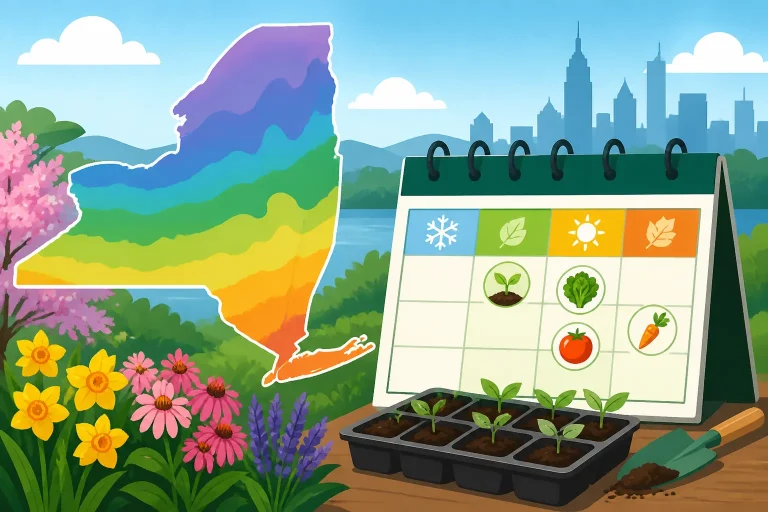
Finding a USDA hardiness zone in New York can help you choose perennials, trees, and shrubs that are more likely to survive winter. But the state’s varied terrain and local microclimates make a ZIP-code lookup only a starting point. Here’s how to check the map, interpret its limits, and use your result without mistaking it for a planting calendar.
What a USDA hardiness zone tells you
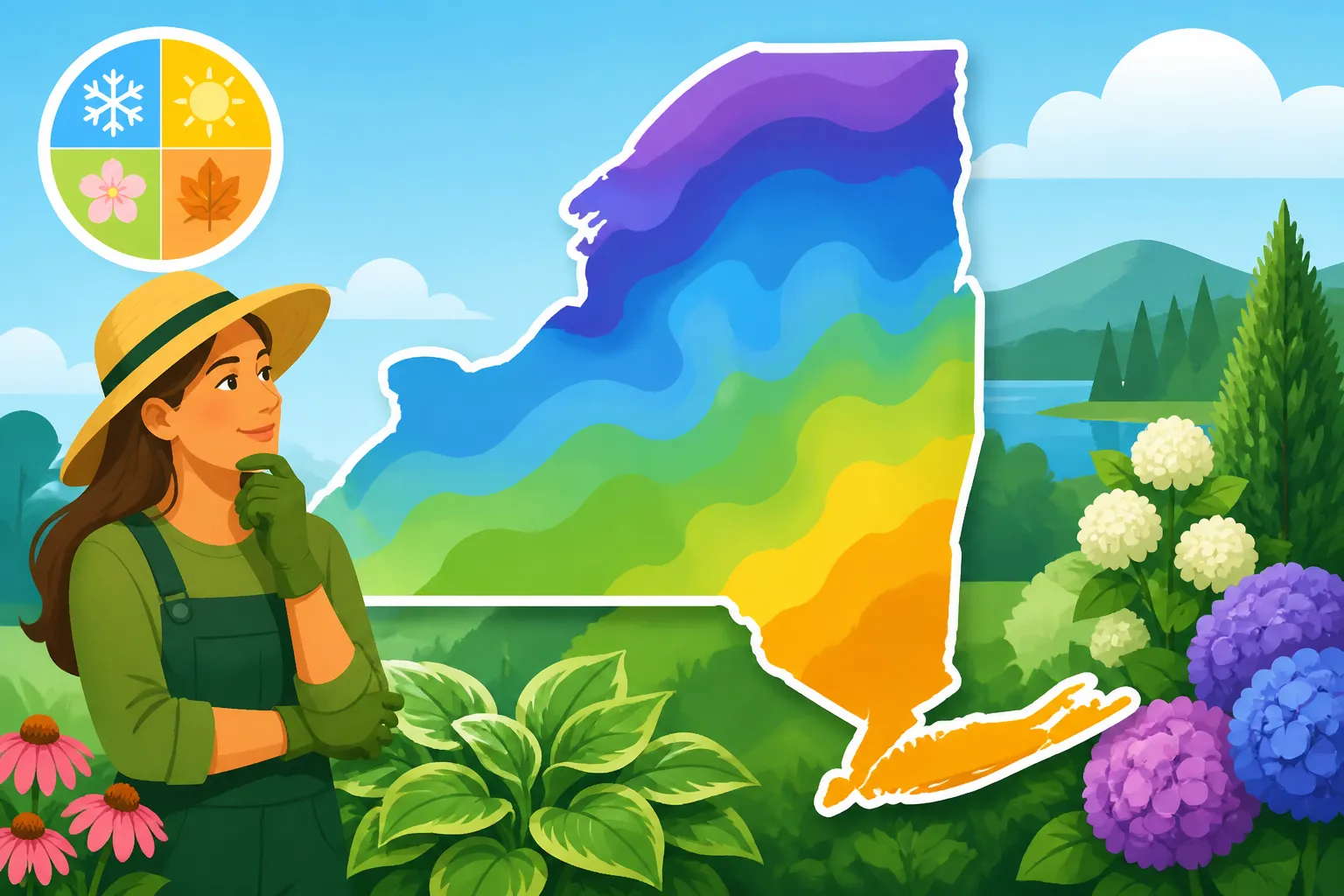
A USDA Plant Hardiness Zone describes the average annual extreme minimum winter temperature for a location. In other words, it summarizes a particular aspect of winter cold over time. The map divides those conditions into zones, with subzones showing finer differences. Its purpose is to help gardeners assess whether a perennial plant is likely to withstand the coldest part of an average winter in a given area.
That makes hardiness zones useful when you’re comparing plants that need to survive outdoors year after year. If a plant’s hardiness range includes the zone where your garden falls, that is a helpful sign. If it does not, the plant may be at greater risk of winter injury. The rating is a guide, not a promise: snow cover, wind, drainage, plant health, and the specific conditions around your home can all affect survival.
A zone is not a measure of your garden’s entire climate. It does not tell you how long your growing season is, when your last spring frost is likely to happen, how often summer heat occurs, or whether your soil drains well. It also doesn’t forecast the lowest temperature in the coming winter. It describes an average based on historical climate information, so an individual winter can be colder or milder.
This distinction matters in New York because the state includes coastal areas, cities, valleys, plateaus, mountains, and open rural sites. Two nearby gardens can experience different conditions because one is sheltered and sunny while the other is exposed or sits in a low spot. A map gives you a regional reference; it cannot describe every garden bed.
Use the zone as one piece of a plant-selection decision:
- For trees, shrubs, and perennial flowers: Check the plant’s winter-hardiness information, then consider exposure, soil, and drainage at your site.
- For annual vegetables: Use frost risk, soil temperature, and crop needs to decide when to sow or transplant. A hardiness zone alone is not a planting date.
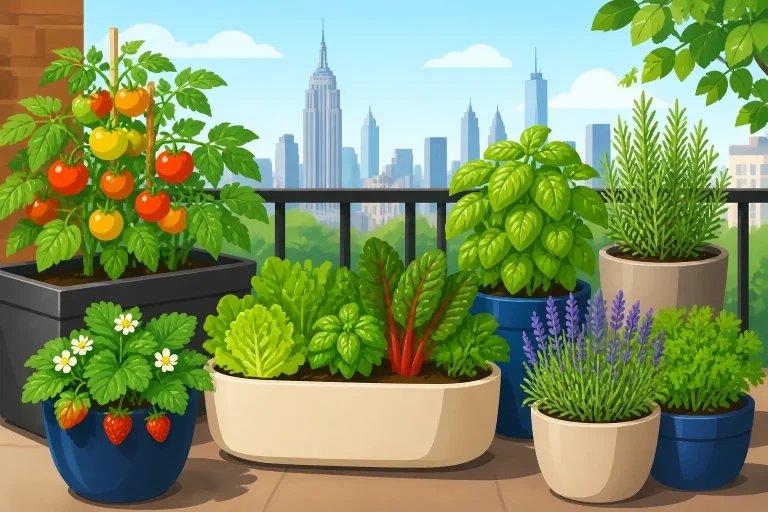
- For container plants: Consider that roots in pots are more exposed to cold than roots in the ground. A plant that survives outdoors in a sheltered bed may not survive the same winter in an exposed container.
- For a plant near the edge of its stated range: Treat the rating as a caution, not a guarantee. A favorable microclimate may help, but a severe or unusual winter can still cause damage.
If your main question is when to sow vegetables, start with Why Frost Dates Matter More Than Hardiness Zones for Sowing Crops. The zone helps with winter survival; frost information helps with seasonal timing.
How to find the zone for your New York garden
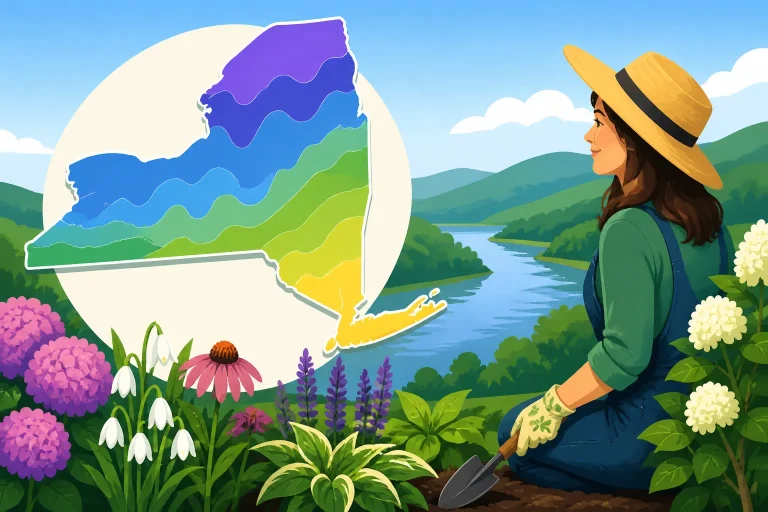
Start with the USDA Plant Hardiness Zone Map and look up the location closest to the garden. You can search by ZIP code or use the map itself to inspect the area. A ZIP-code result is convenient, but it should not be treated as a precise reading for every yard within that ZIP code.
- Look up the ZIP code or map location. Use the USDA map’s current search or map-viewing tool. If your garden is near a ZIP-code boundary, compare the result with the surrounding map rather than relying only on the search label.
- Zoom in on the garden’s setting. Look for local differences shown on the map, and note whether the garden is near a coast, a river valley, a city, a higher elevation, or a broad open area.
- Compare the map with the property. Think about whether the planting site is sheltered by buildings, exposed to wind, shaded, elevated, or located at the bottom of a slope.
- Record the result and the source. Note which map you checked. If you revisit the question later, make sure you are comparing results from the same map rather than mixing zone labels from different editions.
- Use the result as a screening tool. Check whether a plant is rated for your zone, then consider the plant’s other needs and your actual site conditions.
A lookup by ZIP code can be a useful first pass, especially if you are planning a broad landscape or comparing potential plants. For a small garden, the map’s scale and the location of your plot matter. If the property sits near a change shown on the map, a result at the ZIP-code level may not capture which side of that local transition your yard occupies. For more on reading a ZIP-code result, see New York Hardiness Zones: Finding Your Growing Zone by ZIP Code.
When viewing the map, read its legend rather than relying on color alone. Different shades can be difficult to distinguish on some screens or in printed copies. The label and legend tell you what the displayed zone means. If a result seems surprising, check the map location, the ZIP code entered, and whether the map view is showing the intended part of New York.
It can also help to check more than one spot on a larger property. A house lot may include a sunny slope, a sheltered bed beside a building, and a low area that collects cold air. Those are different planting environments, even though they share one address. You do not need to assign a different official zone to each bed. Instead, use the map’s regional result and describe the garden’s real conditions when choosing plants.
Why zones vary across New York
New York’s winter conditions are not uniform from one region to another. Distance from the coast, elevation, landform, and exposure all influence how cold a location can become. That is why a statewide planting plan is often less useful than one adjusted for the actual county, town, and garden site.
Broad geography can help explain why the map changes across the state, but it should not be used to guess an individual garden’s zone. A city name or a regional description cannot account for every slope, shoreline, valley, or sheltered neighborhood. Check the map for the place you are gardening, then look at the conditions right around the bed.
Coast and inland conditions
Coastal influence can moderate some temperature swings, but it does not make every coastal garden alike. A plot near open water may be exposed to wind, while another nearby site may be sheltered by buildings or vegetation. Inland locations can experience different winter extremes, but local topography still matters.
Elevation and landform
Higher ground and mountain terrain can have different cold patterns from nearby lowland areas. Valleys and hollows may collect cold air, while slopes and ridges can be more exposed to wind. The direction and steepness of a slope, nearby tree cover, and surrounding buildings can all affect a planting site.
For practical garden planning, elevation is worth considering alongside the map. How Elevation and Slope Change Local Frost Timing in New York explains why a garden’s position in the landscape can affect frost risk as well as winter conditions.
Cities and built-up areas
Buildings, pavement, and other structures can make some city and suburban sites warmer than nearby open locations. Walls may also block wind or reflect heat. These effects vary across a property and through the seasons. A sheltered urban courtyard, for example, is not interchangeable with an exposed rooftop or a windswept street-side bed.
A warm microclimate can help certain plants, but it should not be treated as a substitute for checking hardiness. A sheltered corner may reduce some cold stress without changing the broader winter conditions represented by the map. For related advice on local planting conditions, see Adjusting Planting Calendars for Mild Urban Microclimates.
Local differences within a region
Even gardens in the same county can differ because of soil, shade, wind exposure, and drainage. The USDA map gives a useful regional baseline, but it is not a property survey. If you garden in a part of New York with sharp changes in terrain, consult the map for the specific location rather than relying on a general regional description.
For a closer look at differences in timing between warmer valleys and cooler sites, see How Milder and Cooler New York Regions Shift Your Sowing Calendar and Adjusting Sowing Windows Between Warm Valleys and Cold Plateaus. These distinctions are especially useful for vegetable timing, which depends on more than winter plant survival.
What a hardiness zone cannot tell you
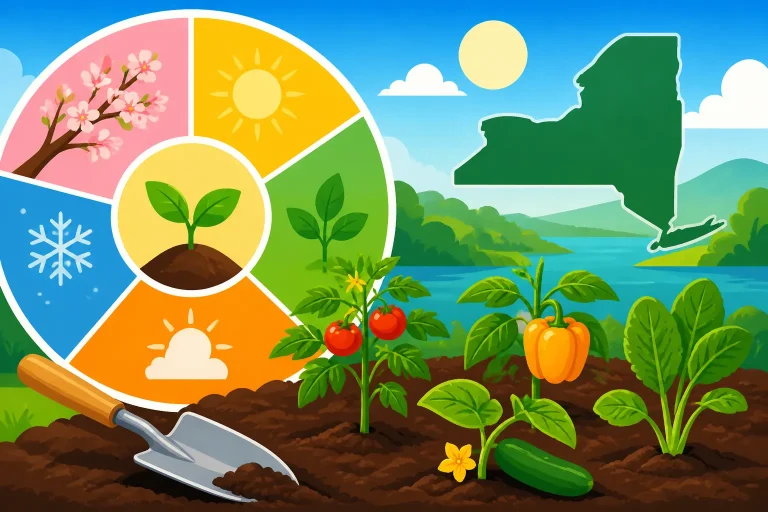
A frequent mistake is to treat the zone as a complete growing-season calendar. It is not. The map focuses on winter minimum temperature, while gardeners need other information to decide when to plant, what will ripen, and how to protect crops.
| Gardening question | Does the hardiness zone answer it? | What to check instead |
|---|---|---|
| Is a perennial likely to survive average winter cold outdoors? | It can help screen choices. | Plant hardiness information and the site’s exposure, drainage, and shelter |
| When is the last spring frost likely? | No. | Local frost-date information and current forecasts |
| When should tender vegetables go outdoors? | No. | Frost risk, soil warmth, crop needs, and forecast conditions |
| How long is the growing season? | Not by itself. | Local frost patterns and crop days to maturity |
| Will a plant tolerate summer heat or humidity? | No. | The plant’s heat and moisture needs and the garden’s summer conditions |
| Will a plant thrive in a wet, shaded bed? | No. | Soil drainage, light, and the plant’s site requirements |
| Will a potted plant survive outdoors in winter? | Not on its own. | Container exposure, root protection, and the plant’s cold tolerance |
It does not give frost dates
Spring and fall frost timing matters directly for many vegetables and annual flowers. A hardiness zone does not state the date when frost is likely to stop in spring or begin in autumn. Average frost dates are probabilities rather than fixed appointments, and actual weather varies from year to year.
Use local frost information to plan tender crops, and watch the forecast as planting time approaches. A stretch of warm weather in spring does not guarantee that the risk of a damaging chill has passed. Likewise, a fall date on a calendar does not ensure a frost on that day. Using Freeze Probability Averages to Schedule Tender Vegetables offers a more suitable framework for timing crops around this risk.
It does not measure soil or moisture
A plant can be hardy enough for the region and still fail in a poorly matched site. Soil that stays saturated, dries out quickly, or compacts easily can cause trouble independent of winter temperature. Light and drainage matter too. A plant suited to full sun may struggle in dense shade, while a moisture-loving plant can suffer in a dry, fast-draining bed.
Before choosing a plant, check the label or reliable plant description for its light, moisture, soil, and drainage preferences. Then compare those needs with the bed. For a garden project, Improving Garden and Lawn Soil in New York can help you think through soil conditions, but do not assume that changing soil alone will make every plant a good fit.
It does not predict every winter
A zone describes an average, not a hard boundary that protects a plant from every cold spell. An unusually cold winter can damage plants that are generally suitable for a location. A mild winter can allow some marginal plants to survive, but it does not establish that the plant will do so reliably over time.
Winter survival also depends on how well a plant is established, whether it has been stressed by drought or disease, and how exposed it is to wind and temperature swings. Snow can insulate some plants when it remains in place, but snow cover is not guaranteed. These factors help explain why two gardeners with similar map results can have different outcomes.
It does not guarantee a harvest
For vegetables, the path from sowing to harvest depends on the crop, the variety, soil warmth, sunlight, moisture, and the length of favorable weather. A zone rating does not say whether a late-maturing crop will finish before fall conditions become unfavorable. Nor does it tell you if the soil is warm enough to sow a heat-loving crop.
Use a crop calendar or a locally adjusted planting schedule for those decisions. New York Vegetable Planting Calendar by Freeze Dates and Hardiness Zones and Sowing Dates: What Your Zone Tells You help separate plant hardiness from planting windows.
How to use your result when choosing plants
Once you have a map result, use it as an initial filter rather than a final verdict. The goal is not to find one number that answers every gardening question. It is to combine a regional cold-hardiness reference with the needs of a plant and the conditions of the exact place where it will grow.
For trees, shrubs, and perennial flowers
Check the full hardiness range given for a plant, not just a listing that says it is suitable for a broad region. Compare that information with your map result. If your location is within the stated range, move on to the plant’s light, water, soil, and mature-size needs. A cold-hardy plant still needs the right growing conditions.
Be more cautious when a plant is described as suitable only for warmer conditions than your map result suggests. A protected site may improve its chances, but protection is not a guarantee. For a long-lived tree or shrub, consider how much time and effort you are willing to invest in winter protection and whether a better-matched alternative would be more dependable.
For plants near the cold end of their tolerance, consider:
- Whether the planting site is exposed to winter wind.
- Whether water drains away or remains around the roots.
- Whether nearby walls, paving, or vegetation create shelter.
- Whether the plant is fully hardy in the ground or more vulnerable in a container.
- Whether the plant is well established before facing its first winter.
For vegetables and annual flowers
A perennial hardiness rating is not a sowing date. Annual vegetables and flowers are often grown for one season, and their timing depends on frost tolerance and growing conditions. A crop that grows well in a New York summer may still need careful spring timing.
Sort crops by what they need: some tolerate cool conditions; others are damaged by frost or need warmer soil to germinate and grow. Use frost information for the season, and check soil warmth where it matters. For specific planting windows, see New York Vegetable Planting Calendar by Freeze Dates and Spring and Fall Planting Windows for Cool-Season New York Crops.
For containers and small spaces
Plants in pots face colder root conditions than plants with roots insulated by garden soil. A pot sitting on a balcony, deck, or paved surface may also be exposed to wind from several directions. A plant that is hardy in a landscape bed may need extra protection, a sheltered location, or another winter plan when grown in a container.
Small sites can have useful microclimates, but they can also change quickly. A wall may create a warm corner while a balcony edge remains exposed. Check the plant’s needs and the actual location of the container rather than relying only on the map result for the ZIP code.
For a plant on the edge of its range
A marginal choice can be reasonable if you understand the risk. A gardener may want to test one plant in a protected spot before committing to several. That approach is less costly than replacing a whole border after a difficult winter, but it is still an experiment rather than a guarantee.
If you prefer reliable performance with less winter protection, select plants comfortably suited to the map result and the garden conditions. If you are willing to accept occasional losses, a plant near the edge of its range may be worth trying in a favorable microclimate. Be clear about the trade-off: shelter can help, but it cannot control every winter.
Use a separate plan for planting dates
For vegetables and other seasonal crops, build a planting plan from local frost information, crop requirements, and the condition of the soil. The hardiness zone can provide context, but it should not decide the date.
A practical process looks like this:
- Identify the crop’s cold tolerance. Check whether it can handle cool weather, light frost, or only warm conditions. Do not assume that two crops with similar-looking leaves have the same tolerance.
- Check local frost probabilities. Use information relevant to the garden’s area, and remember that average dates are not promises. A forecast close to planting time can change the decision.
- Check soil conditions. Cold, wet soil can delay sowing or transplanting even when the calendar suggests it is time. Wait until the bed is workable and appropriate for the crop.
- Account for the crop’s time to maturity. Compare the expected harvest period with the local growing season. Choose a suitable variety and allow for slower growth during cool or cloudy conditions.
- Adjust for the site. A sheltered bed may warm earlier than an exposed one, while a low or shaded spot may stay cool longer. Treat these as local adjustments, not new official zone assignments.
- Keep a simple record. Note sowing and transplant dates, weather setbacks, and harvest results. Over time, these observations can help you fine-tune a schedule for your own garden.
The timing of warm-season crops requires special care. Tender plants are vulnerable to cold, and warm soil supports better establishment for many of them. Do not use a zone lookup as permission to set plants out during an early warm spell. When to Plant Warm-Season Crops in New York Gardens and Safe Dates for Setting Out Peppers and Eggplant Across New York address those decisions more directly.
A similar distinction applies in autumn. A plant’s winter hardiness does not tell you when to sow a fall crop or whether it will mature before cold weather. For vegetables, work backward from the expected harvest and the local conditions. How Late Can You Sow Vegetables in New York for an Autumn Harvest? covers that separate timing question.
The broad lesson is straightforward: use zones to screen plants for winter survival, and use frost and crop information to schedule seasonal planting. Combining the two prevents a common frustration: choosing a plant that can survive winter but sowing it at the wrong time, or planting a crop on schedule for a different part of the state.
Common hardiness-zone mistakes to avoid
A few habits make zone information less useful than it could be. Avoiding them can save time, reduce plant losses, and make a garden plan better suited to its actual site.
Treating a ZIP-code result as a yard measurement
A ZIP code is a convenient way to search, not a detailed survey of every planting location within it. If the property is near a mapped transition, or if the garden is unusually exposed or sheltered, look closely at the map and the site. Do not assume every bed at one address has identical conditions.
Assuming the map guarantees survival
A suitable zone rating improves the odds that a plant can cope with average winter cold. It does not guarantee survival through every winter or protect a plant from waterlogged soil, drought, wind, disease, or poor establishment. Read the full plant description and choose a suitable location.
Using a zone to set spring planting dates
This is one of the most common mix-ups. A hardiness zone is about winter minimums, not the date when it is safe to sow or transplant a particular crop. Use local frost probabilities and crop-specific guidance instead.
Confusing survival with good performance
A plant may survive winter and still flower poorly, grow slowly, or struggle in the wrong soil or light. The zone addresses one risk, not every condition that determines whether a plant will thrive. Match the plant to the whole site, not just the cold rating.
Ignoring containers and exposed structures
A rooftop, porch, or balcony can have a different combination of wind, sun, and root exposure from an in-ground bed. The map remains useful as regional context, but container roots may need more protection. Check the particular plant and the container’s location before leaving it outdoors through winter.
Applying information from a different region
Planting advice from another state or a different part of New York may not match the timing or conditions in your garden. Even within the state, local frost patterns and terrain can shift the schedule. Choose guidance that fits the location and the question you are trying to answer.
Looking at the zone but not the map legend
Map colors alone can be misleading, especially on a small screen or in a printed image. Read the legend and verify the map’s search result. If you are comparing results from different sources, confirm that they refer to the same map rather than combining labels from separate editions.
Frequently Asked Questions
Does a USDA hardiness zone tell me when to plant vegetables?
No. It helps assess winter survival for perennial plants, but it does not provide a sowing or transplanting date. Use local frost information, soil conditions, and crop-specific timing.
Can one New York ZIP code include different garden conditions?
Yes. A ZIP-code lookup is a regional starting point, not a measurement of every yard or bed. Elevation, slope, shelter, wind, and buildings can create meaningful local differences.
If a plant is rated for my zone, will it definitely survive winter?
No. The rating is a useful screening tool, not a guarantee. An unusually cold winter, poor drainage, wind exposure, plant stress, and other site conditions can affect survival.
Should I choose plants only by hardiness zone?
No. Check light, soil, moisture, drainage, mature size, and summer needs as well. For vegetable timing, use frost and crop information rather than the hardiness rating alone.
Disclaimer
This article is for general informational purposes only and does not constitute professional advice. Laws, prices and regulations vary by location and change over time. Consult a qualified professional for guidance on your specific situation. New York Gardening Guide is not a government agency and is not affiliated with any university extension, state department of agriculture or other government agency.